
Engineered by Nature - We studied whale tubercles, fish gills, mangrove roots, shark skin and coral - and built millions of years of natural engineering directly into our flow conditioners.

Easy to Install

Engineering Out the Failure: A Technical Deep Dive

We identified four “Critical Path” installation errors that account for over 60% of field failures. Our architecture addresses these through Active Topology Management and Embedded Hardware Gates.

1. Velocity Skew & Profile Disturbance (E1 and E2 Modes)

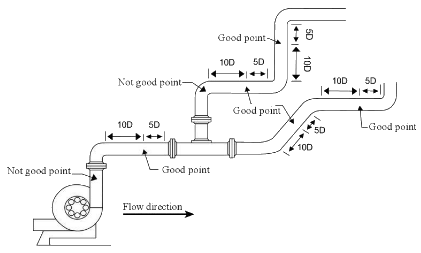
  • The Industry Problem: Traditional meters require “fully developed” profiles. Placing a meter near a valve or elbow creates massive velocity skews and swirl, leading to errors often exceeding 5%.
  • Our Solution (Flow Conditioning Architecture): Our meter utilizes an integrated, multi-stage conditioning architecture. This system mechanically dissipates macro-swirl and stabilizes the velocity profile within the meter body itself.
  • The Result: Commercial accuracy of ≤0.5% even in “Zero-Run” (0D/0D) environments, verified by a 90-point acceptance matrix.

2. Rotational Misalignment (Electrode Clocking)

  • The Industry Problem: If electrodes are positioned at 12 and 6 o’clock, they are susceptible to air pockets and sediment interference, leading to “silent” signal drift.
  • Our Solution (Orientation Logic Gate): We utilize an embedded spatial reference sensor on the main controller.
  • The Result: The firmware polls the gravity vector during a 2-second boot sequence. If the electrode plane is not within horizontal tolerance, the system asserts a “Red” status and blocks measurement start.

3. Partial Fill & Entrained Air

  • The Industry Problem: Mag meters assume a 100% full cross-sectional area. If the pipe is partially empty, the meter over-reports flow significantly.
  • Our Solution (Active Continuity Monitoring): The system continuously monitors electrode-to-liquid-to-ground continuity.
  • The Result: Measurement is automatically paused if an invalid fill condition is detected. Rather than outputting erratic data, the meter triggers an explicit operator prompt: “Pipe empty – measurement paused”.

4. Grounding Loops and Reference Shifts

  • The Industry Problem: Mag meters measure micro-volt signals. Failing to install external grounding rings on non-conductive pipes introduces noise that can drown out the signal.
  • Our Solution (Integrated Grounding Path): We have engineered a low-impedance grounding reference directly into the meter’s internal architecture.
  • The Result: The dependency on external, customer-provided grounding hardware is removed. This is validated through a mandatory Grounding Integrity Gate, ensuring reference stability even in high-interference environments.

The Final "Serviceability" Proof: Quarter-Turn Replacement

  • The Mechanical Barrier: Traditional electrode replacement requires depressurizing the line and unbolting the meter body.
  • Our Engineered Solution: We utilize a proprietary quarter-turn cartridge system featuring redundant pressure-seals and anti-extrusion technology.
  • The Result: A validated 11-minute field replacement (P90) while the pipe remains pressurized at 16 bar. This is achieved via a keyed-orientation housing that prevents incorrect insertion.

Here is the patent-safe technical deep dive into our Predictive Maintenance Physics, explaining how we use sensor intelligence to manage the electrode interface without disclosing the proprietary “how” of our micro-cavitation or scour-jet internals.

© 2023, Mag Flow Meter