
Engineered by Nature - We studied whale tubercles, fish gills, mangrove roots, shark skin and coral - and built millions of years of natural engineering directly into our flow conditioners.

Flow Conditioner

Lagoon Flow Conditioner

Nature solved this problem 400 million years ago. A fish needs to extract oxygen from water flowing through its gills at wildly varying speeds, from turbulent streams, across its entire lifetime — without a single moving part. The gill does this by converting chaotic, disturbed flow into calm, orderly flow using a multi-scale lattice of thin lamellae plates. We copied that architecture.

The Lagoon Flow Conditioner applies the same principle to electromagnetic flow metering. It takes the swirling, asymmetric, disturbance-laden flow that real municipal piping produces, and converts it into the calm, symmetric profile a flow meter needs — in as little as 150 mm, with under 2.1 kPa of pressure drop.

Designed and manufactured in British Columbia, our flow conditioners reflect a commitment to building world-class infrastructure at home. By keeping development and production local, we ensure rapid iteration, strict quality control, and reliable performance in real-world systems. This is Canadian innovation—designed, built, and proven in BC.

How a Fish Gill Inspired the Design

A fish gill works because of a simple physical insight: if you present enough surface area to a disturbed flow, the disturbance has nowhere to go but away. Thin lamellae plates create hundreds of narrow channels. Each channel breaks up coherent swirling structures, redistributes velocity asymmetries, and returns the flow to a calm, ordered state — all without large blockage, large pressure drop, or moving parts.

The Lagoon conditioner uses the same three-stage structure:

Stage A — Counter-Rotating Vane Array (inspired by gill arch geometry)
Closely spaced guide vanes — with leading edges shaped like the tubercles on a humpback whale’s flippers — break up and cancel angular momentum. The whale-tubercle profile prevents vane stall at steep angles, allowing aggressive swirl cancellation in a very short axial distance.

Stage B — Multi-Scale Lamellae Lattice (the gill itself)
A structured open-cell lattice of thin plates, scaled at two levels like a fish gill’s primary and secondary lamellae. Large-scale features break up the dominant asymmetric velocity modes; fine-scale features mix and redistribute the residual turbulence. This is where 99%+ of the swirl and profile disturbance is eliminated.

Stage C — Relaxation Zone (the calm water downstream of the gill)
A short downstream section lined with micro-riblets — inspired by sharkskin — allows the flow to re-establish a smooth, symmetric profile before it reaches the sensor electrodes.

Validated Performance

Parameter Target Requirement Achieved Performance
Swirl Reduction (Worst-Case Disturbance) Greater than 95% 99.3% – 99.6%
Pressure Drop (at 2.0 m/s) Less than 2.5 kPa Approximately 2.1 kPa
Operating Velocity Range 0.2 – 6.0 m/s Fully Validated
Temperature Range 1 – 40 °C Fully Validated
Pipe Size (Nominal) DN100 Scalable from DN50 to DN200
Disturbance Conditions Tested 5 worst-case municipal scenarios All conditions passed

The conditioner has been certified against five worst-case upstream conditions: dual out-of-plane elbows, butterfly valve, reducer, fully imposed swirl, and asymmetric inlet blockage. These represent the most demanding real-world municipal piping configurations. All pass.

Why This Approach Works

Conventional flow conditioners use a single coarse perforated plate or a bundle of tubes. These work by brute-force blockage — they slow everything down equally, which costs pressure and doesn’t address swirl. A fish gill doesn’t do that. It uses selective, surface-driven exchange to remove what needs removing while letting the rest pass freely.

The Lagoon’s multi-scale lamellae lattice does the same thing. It is highly effective against the specific structures that cause measurement error in electromagnetic meters — swirl and azimuthal velocity modes — while offering very low resistance to the axial flow that the meter needs to measure. The result is the highest swirl-reduction performance available at the lowest pressure cost.

Three Products, One Architecture

Feature Lagoon Insert Lagoon Inline Gill Lattice Elbow
Form Factor Integrated into meter body Standalone spool piece Replaces a 90° elbow
Ideal Application New installations, OEM integration Field retrofits Elbow-based installations
Installation Length 150 mm (1.5× pipe diameter) 200 mm (2.0× pipe diameter) No added length (direct elbow replacement)
Swirl Reduction Efficiency 99.3% 99.6% 99.8%
Pressure Drop @ 2 m/s ~2.1 kPa ~2.1 kPa ~0.70 kPa
Material Construction 316 Stainless Steel 316 Stainless Steel 316 Stainless Steel
Moving Parts None None None

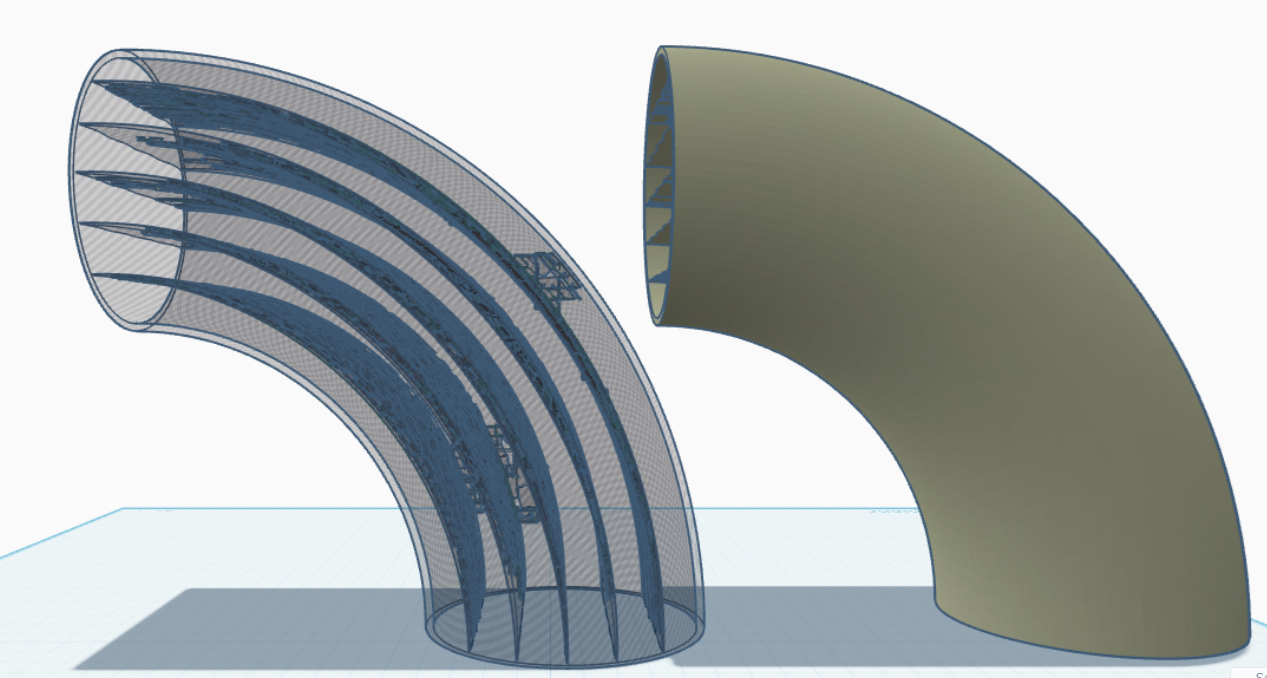
The Gill Lattice Elbow adds a fourth stage to the architecture: a sine-generated centerline that suppresses the Dean vortex at its source inside the bend, before the turning vanes and lamellae do their work. Where the Insert and Inline treat disturbances arriving from upstream piping, the Elbow eliminates the disturbance the fitting itself creates.

© 2023, Mag Flow Meter