When water flows around a bend, it spins. The outer wall accelerates the flow, the inner wall decelerates it, and a counter-rotating pair of vortices — the Dean vortex — forms and persists for tens of pipe diameters downstream. This is the most common cause of measurement error in municipal electromagnetic metering.
Fish gills have always faced this problem. Blood flowing through gill arch passages is constantly disturbed by the fish’s breathing motion and the turbulence of the surrounding water. The gill solves it the same way every time: surface-driven exchange. Thin lamellae plates break up coherent vortex structures and return the flow to an ordered state — without large blockage, without large pressure loss.
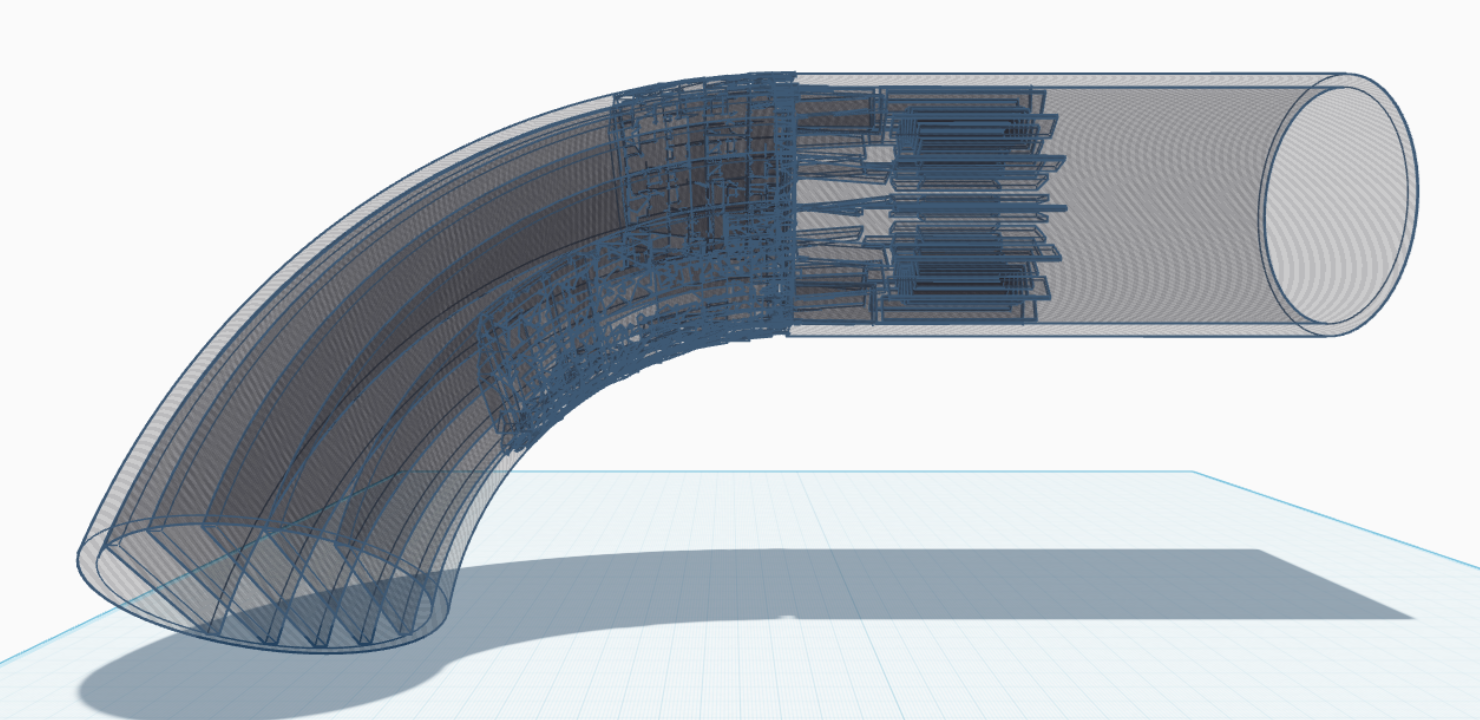
The Gill Lattice Elbow Conditioner combines this principle with a second idea from nature: the sine-generated curve. Rivers that carve their own paths through soft ground naturally follow sine-generated meanders — the mathematically optimal curve that minimises flow separation and vortex formation at a bend. The Elbow’s centerline follows this same geometry, reducing the Dean vortex before it fully forms.
The result is a four-stage architecture that works with the physics of the bend rather than fighting it afterward:
Sine-generated centerline (the river’s own curve)
The elbow body follows a mathematically optimal bend profile that suppresses Dean vortex generation at the source. The vortex enters the conditioner already weakened.
Turning vane array (whale tubercles inside the arc)
Six closely-spaced turning vanes mounted inside the elbow arc intercept the developing Dean vortex and cancel its angular momentum. Leading edges are shaped with humpback whale tubercle profiles — the same geometry that prevents stall on a whale’s flipper. This design allows aggressive vortex capture at the steep angles required without flow separation.
Lamellae lattice (Stage A/B) (the gill itself)
The residual swirl leaving the turning vanes passes through a two-scale open-cell lamellae lattice. Large-scale features break the remaining coherent mode structures; fine-scale features redistribute residual turbulence. Together they reduce swirl from the Dean vortex source to a residual below 0.001 which is a 99.8% reduction from the raw elbow inlet.
Relaxation zone (Stage C)
A short downstream section allows the conditioned flow to settle into a fully symmetric profile before it reaches the sensor electrodes.